

The question to ask yourself
Can you track your sales peaks? Are your sales staff's breaks planned around them?
Hours paid for nothing, and customers left waiting at rush hour.
Your peak hours, day by day and hour by hour:


Point-of-sale and stock software that supports RFID, and barcodes too.
100 TND a month, locked for the first 50 retailers until 31 October.
See the offerFrom fashion shops to the workshops that supply them.
Sizes, colours and sales: every item tracked.
Sizes and boxes counted without unpacking.
The tag applied at source, before shipping.
Transfers between sites and consolidated stock.
99.5%
Uptime
Platform service target
< 47ms
Checkout latency
From scan to the line on the receipt
< 100ms
Gate latency
Theft detection, decided locally
99.9%
Stock accuracy
Full inventory in 2 hours, without closing
Seven situations retailers live with, and what TuniRFID shows you instead.
The question to ask yourself
Hours paid for nothing, and customers left waiting at rush hour.
Your peak hours, day by day and hour by hour:
What we hear in every shop
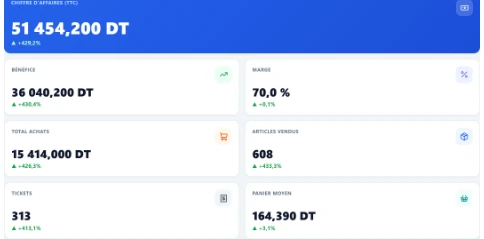
Steering by revenue alone means discounting without knowing it.
Your profit and your margin, not just your revenue:
What we hear in every shop
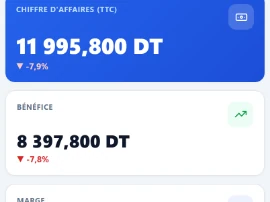
Having to be there to know means staying behind the counter.
Your shop on your phone, wherever you are:
The question to ask yourself
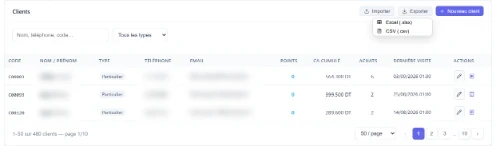
A file locked inside a piece of software is a shop that can no longer change.
Your data leaves with you, in Excel or CSV:
What we hear in every shop
A campaign nobody counts gets repeated the next year, blind.
Your promo code, and how many times it was used:

The question to ask yourself
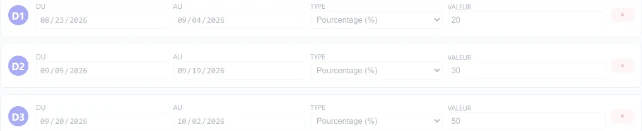
Two evenings per markdown, after closing, and one pricing mistake costs the margin.
Your markdowns, scheduled once and for all:
What we hear in every shop
The most effective clearance tool in the trade goes unused.
Your offers, applied automatically at the till:

100 TND a month
One shop. Yearly, 1 000 TND: 10 months paid for 12.
10-day trial
One platform, two levels of commitment. Moving from one to the other changes neither the screens nor your teams' habits, only how precisely stock is tracked.
Digitise checkout and stock without changing your labels.
Independent stores that want a reliable till and accurate stock, using the barcodes they already print.
The scan puts the line on screen before your hand leaves the scanner. No queue is ever created by the software.
Internet outage or a dead ADSL line: the till keeps taking payments locally, then replays the queue on reconnection.
Guided opening, cash movements, close-out by payment method, 80 mm ESC/POS receipt.
EAN13 / GTIN, label generation and reprinting. No proprietary hardware imposed.
Campaigns, progressive markdowns, basket rules and promo codes, with compliant dual pricing on the receipt.
Any existing PC or till, thermal printer and off-the-shelf scanner.
Every piece identified, from the factory to the receipt.
Retail and apparel chains that want stock to stay accurate permanently, and an inventory count that no longer closes the store.
Source tagging at the factory, then individual tracking: goods-in, transfer, sale, return, piece by piece.
A full store count without closing the doors or stopping sales, against several days by hand.
Decided locally in under 100 ms, alarm on repeated reads, fail-closed operation even with the network down.
The discrepancy is no longer discovered at inventory time but as it happens, with the item and location named.
Fixed and mobile readers driven by the in-store application: per-antenna calibration, anti-collision filtering.
The RFID point of sale and its tills are part of the subscription, with reading hardware driven out of the box.
| Capability | Barcode | Premium RFID |
|---|---|---|
| Checkout, catalogue and stock | Included | Included |
| Works offline | Included | Included |
| Sales, promotions, returns | Included | Included |
| Identification | By reference | By item (EPC) |
| Full inventory count | Manual, store closed | 2 hours, doors open |
| Shrinkage detection | At inventory time | In real time |
| Exit gate | Not included | Included |
| Source tagging at the factory | Not included | Included |
| Delivery-note OCR | Group offer | Included |
| Reading hardware | Any off-the-shelf scanner | Zebra / Hopeland, driven |
An item created in the back office is sellable at the till within a second. Every sale flows back as a stock movement, traced down to the piece. No exports, no re-keying, no version drift.
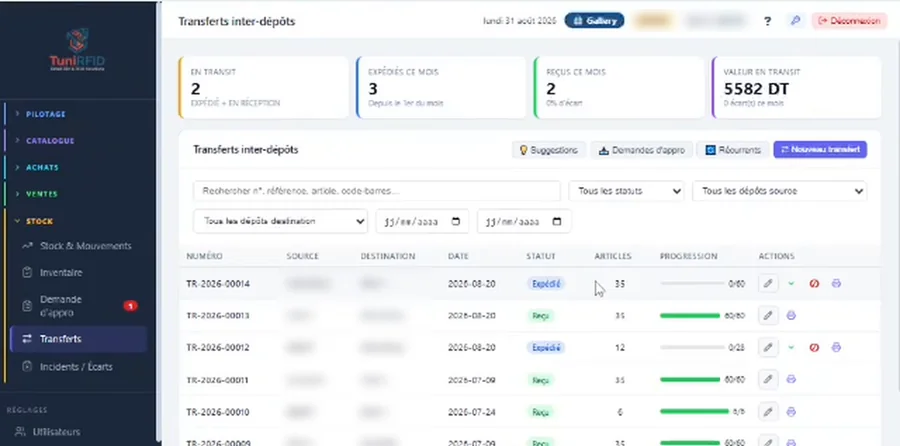
The desk
Catalogue and size × colour matrix, deliveries and transfers with approval, 15 indicators, 7 / 30 / 90 / 365-day reports and target-based oversight.
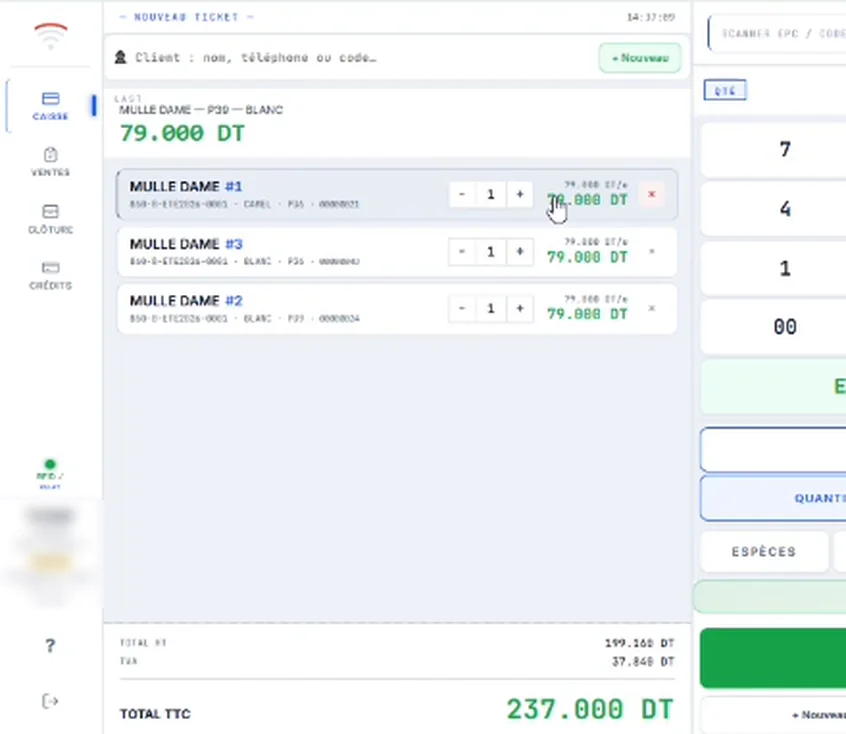
The counter
Barcode and EPC checkout on one screen, returns and exchanges in a click, oversell protection, Z close-out by payment method.
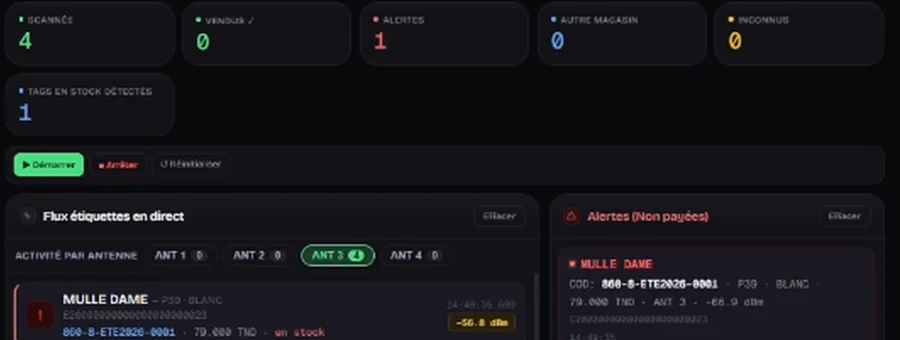
The floor
A local executable drives readers and the gate: automatic reconnection, self-healing on heartbeat, theft decisions taken even with the network down.
A wrong quantity at goods-in distorts theoretical stock, then replenishment, then the inventory that uncovers the gap months later. Item-level tracking cuts the chain at its source.
The RFID label is applied at source, on the production line or at packing.
The pallet arrives through a bulk read: goods-in is counted in minutes, not hours.
Stock in transit stays visible on its own: neither at the sender nor at the receiver.
Stockroom and sales floor are two distinct locations, not one blurry total.
The item sold leaves stock down to the EPC, and the gate stops seeing it.
A return lands in an isolated location; faulty goods are never put back on sale.
The in-store application configures N antennas, separates till and gate roles, calibrates each read point and filters collisions. You choose hardware to suit the store, not to suit the software.
Prints the price and writes the ID into the chip in a single pass.

Stock counts, goods-in and item search, even through a closed carton.

At the till, a bag set down is read in one go.

An unpaid item shows up with its style, size and price.
Photos taken at Parici Gallery, Sfax. Zebra and Hopeland are registered trademarks of their respective owners, mentioned here for hardware compatibility only.
From February to August 2026, TuniRFID ran every day at Parici Gallery in Sfax: checkout, goods-in, stock counts, RFID labelling. What follows was filmed on site, with the hardware actually installed there.
The delivery note is validated, then the labels go to print. The printer does two things in a single pass: it prints the price and the reference, and it writes a unique identifier into the chip, one that belongs to that single garment. Two identical items, same model, same size, same colour, do not share an identifier. That is the whole difference from a barcode.
A fixed four-antenna reader under the checkout counter, and a handheld for everything that moves: stock counts, goods-in, finding an item on the shop floor.
The handheld sees nothing, and does not need to. Within seconds the list fills up: every piece announces itself, through the sealed box. The reading then goes back into the platform, where it is reconciled against the transfer note line by line: what matches, what is missing, what is in excess.
The customer puts her bag on the counter. She does not empty it. The three items enter the receipt together. Payment proceeds normally (cash, card or cheque) and every item sold is marked as such, to the second.
The gate reads what passes and asks a single question: has this item been paid for? A paid item passes without triggering anything. One that has not appears on screen, with its model, size, price, and the antenna that saw it go by.
Launch offer31 October 2026
A promotion always climbs back up. Here it is the other way round: the rate you sign now stays put for as long as your subscription runs. It is the published grid that goes up, for the ones who come after.
Your rate stops moving. It lives on your subscription, not in the catalogue. When the grid rises, it rises for new customers.
Whichever comes first: the 50th signed subscription, or 31 October 2026. Running subscriptions keep their rate.
Everything is included: licence, updates, monitoring and support. No hidden fees, no capital tied up.
Checkout, catalogue and stock on the labels you already print.
One store, a till that doesn't go down.
100TND
per month · per store
10-day trial
Locked pricethen 130 TND from 1 November
Start the trialSeveral outlets and a warehouse, one single stock truth.
150TND
per month · per network
10-day trial
Locked pricethen 195 TND from 1 November
Start the trialBeyond three outlets, the scope is built with you.
On request
Scope defined with you
Item-level traceability, exit gate and reading hardware, all driven by the platform.
Item-level traceability, hardware and software included.
1 000TND
per month · per store
RFID label consumables and reading hardware are quoted separately, based on volume and store layout.
Amounts exclude tax and are in Tunisian dinars. The Group offer is scoped on the number of sites and the interfaces to connect.
Isolation between retailers is not a filter applied in code: it is a separate database per client. A forgotten filter therefore cannot expose someone else's data.
No data is pooled between clients. The isolation is structural, not an application filter someone can forget.
A dedicated instance on the retailer's own cloud account, under their control and their billing.
Every in-store machine authenticates with an anti-clone HMAC; updates are verified with SHA-256.
Multi-tenant Prometheus and Grafana, business metrics at checkout, alerts routed by severity.
A question that isn't here? It deserves a straight answer, not a brochure.
Send us an extract of your catalogue: we load it, we tag a few pieces, and you watch stock move live on your own references.
Already a customer? Every retailer who subscribes on your recommendation earns you one free month. Give us their name, or pass on your link.